Posts

The Diary of Adam Martin

Image
This diary belonged to Adam Martin, who wrote in it from 1770 to 1780. Adam Martin was born on August 27th, 1739 in Sturbridge, Worcester, Massachusetts Bay Colony, to Aaron Martin and Sarah Newell. Adam married Abigail Cheney in Sturbridge on December 19th, 1762. Adam and Abigail had five daughters and at least one son. Adam joined the military in 1775 and was a captain in the Revolutionary War, first in Col. Ebenezer Learned’s 14th Massachusetts Bay Provincial Regiment in 1775, then in Col. Timothy Bigelow’s 15th Massachusetts Regiment, Continental Army in 1777. Adam and Abigail's son Walter became a brigadier general in the War of 1812, established the village of Martinsburg in New York in 1803, and served in the New York State Senate. Walter's son Morgan Lewis Martin is someone Green Bay history buffs are more familiar with. In addition to building Hazelwood Historic House and serving as a Brown County judge, Morgan L. Martin was a delegate to the U.S. House of Representat...

Native American Heritage Month: Ada Deer

Image
Ada Deer was born in Keshena, WI as a member of the Menominee Tribe in 1935. She lived most of her first eighteen years of life on the Menominee Indian Reservation in a cabin without electricity or running water.  Her mother instilled in her a drive and passion to be a strong advocate for Native American rights. Ada was the first Menominee to earn an undergraduate degree from the University of Wisconsin and the first Native American to receive a Master of Social Work degree from Columbia University. She went on to become the first woman chair for the Menominee Tribe in Wisconsin. She played a major role in the Menominee Restoration Act of 1972, which officially returned the Menominee Reservation to federally recognized status. She acted as a spokesperson in Washington, D.C. and lobbied to return federal recognition and protection to the tribe. She was then elected chairperson of the Menominee Restoration committee and had the task of making the transition back to reservation st...

Local Protests of the Kent State Shootings

Image
Richard Nixon ran for President in 1968 with the promise that he would end the Vietnam War. However, on April 30, 1970, President Nixon announced on live television and radio that the United States would be invading Cambodia. This led to many protests on campuses across the country. Protestors at Kent State University in Ohio launched a demonstration on Friday, May 1st, including various types of rallies and speeches. That evening, socializing in downtown Kent quickly escalated into a violent confrontation between protestors and police, which included building bonfires, stopping cars, throwing bottles at police cars, and breaking store windows. This prompted the Mayor of Kent, Leroy Satrom, to contact the governor of Ohio requesting assistance from the Ohio National Guard. On May 3rd, approximately 1,000 National Guard soldiers were sent to the Kent State campus and tensions remained high.   During an incident on May 4, 1970, members of the Ohio National Guard opened fire into...

Portraits

Image
One of the things we are excited about for the Generations Gallery going forward is that the space allows us to make changes and rotate artifacts.  The exhibit opened in August 2020, and we are excited to share we opened our first new rotation last week!  The first rendition of the Art section featured Nature in Art.   Now we are rotating in Portraits.   These depictions of people from all different time periods and backgrounds are all from the Neville Public Museum’s collection.   You might even recognize a few artist or sitters.   Here are 5 things you want to look for!   Fear George Catlin George Catlin (1796-1872), well-known for his paintings of Native Americans, drew a series of self-portraits in 1821. They found their way to Green Bay through his nephew, Theodore Burr Catlin. George Catlin did the self-portraits at night, before a mirror, simulating facial expressions of various emotions. The drawings all have similar facial outlines...

On this Day: President Lincoln Laid to Rest

Image
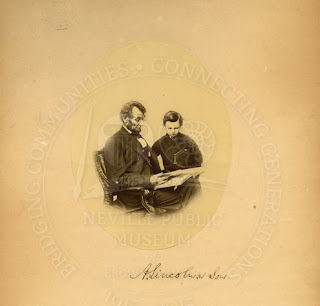
Abraham Lincoln was laid to rest on April 28, 1865 in Springfield, Illinois. Following his assassination two weeks earlier, his body was laid in state in the nation's capital and was transported to Springfield by train. Lincoln spent time in Wisconsin during his brief military career, serving in the Black Hawk War, and last visited the state in 1859 as a potential presidential candidate. The Neville Public Museum is proud to hold in our collection a signed photograph of the president and his son Tad, taken in 1864. Lincoln rarely signed photographs, but two signed copies were gifted to the president's secretary Gustav Matile about one year before Lincoln's death. After Lincoln was assassinated, Matile worked as a lawyer in Minnesota and then served as U.S. Court Commissioner for Wisconsin's Eastern District in Green Bay. When Matile died in 1908, he gave the photograph to the Kellogg Public Library, where it was kept until sold to the Green Bay & De Pere Antiquari...

Green Bay’s Titanic Ties are Unsinkable

Image
On April 14, 1912 the RMS Titanic hit an iceberg in the North Atlantic. It sank less than three hours later in the early morning of April 15, 1912.  The sinking of the RMS Titanic may feel distant in time and place but Green Bay has deep connections to the disaster. Dr. William E. Minahan, who died on the Titanic, is buried in a crypt in Woodlawn Cemetery, visible from Riverside Drive.   Dr. Minahan was traveling home from Europe with his wife, Lillian, and sister, Daisy, after an extended vacation abroad.   The Minahans had planned on sailing home sooner but a coal strike prevented their intended ship from leaving.   They thought they were lucky having been able to book first class tickets on Titanic, but history would prove otherwise. On the night of the sinking, Dr. Minahan put his wife and sister into a lifeboat telling his wife, “Be brave.   No matter what happens, be brave.”   Those were Dr. Minahan’s final words.   His family received news o...

Women of Brown County: Syble Hopp

Image
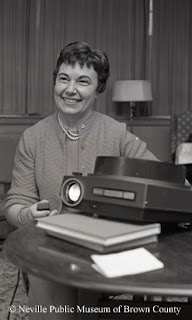
Syble interviewed for a teaching position with the Superintendent of Brown County Schools, Joe Donovan, in the 1950s. He knew instantly that she was destined to do more than teach kindergarten. Joe’s dream was to create a program for students with special needs, and he knew Syble was the one to do it. Syble’s special needs program started with one classroom and grew into its own school, named in her honor. Starting the program was not an easy task. At the time many students with special needs did not attend school. Syble went door to door to recruit students and meet with parents. She eventually became a leader in Special Needs Education. Syble advocated for her students and other children with special needs, as she believed they deserved the chance to receive an education and the opportunity to have days full of fun and creativity. Her dedication not only touched her students but also the teachers she worked with and mentored. Because of her work, the school is still open today. I...